 XIA LEI
Our Most Familiar Alien World
Mars is the fourth planet from the Sun and the most explored world after Earth. More than fifty spacecraft have been sent to it. Several are still working there today, and its surface has been mapped in more detail than parts of our own ocean floor.
It is also the planet most likely to be humanity's second home. You can watch where it is right now on our interactive Solar System map. If you want the practical side of going there, read our guide on how to land on Mars and survive.
Mars at a Glance
| Mars | Earth | ||
|---|---|---|---|
| Diameter | 6,779 km | 12,742 km | |
| Gravity | 0.38 g | 1 g | |
| Length of day | 24 h 37 min (a "sol") | 24 h | |
| Length of year | 687 Earth days | 365 days | |
| Distance from the Sun | 1.52 AU (228 million km) | 1 AU | |
| Average temperature | about −63 °C | about 15 °C | |
| Atmosphere | 95% carbon dioxide, under 1% of Earth's pressure | 78% nitrogen, 21% oxygen | |
| Moons | 2 (Phobos and Deimos) | 1 |
Mars is about half Earth's width, but its land area roughly matches all of Earth's continents combined, because it has no oceans.
Why Is Mars Red?
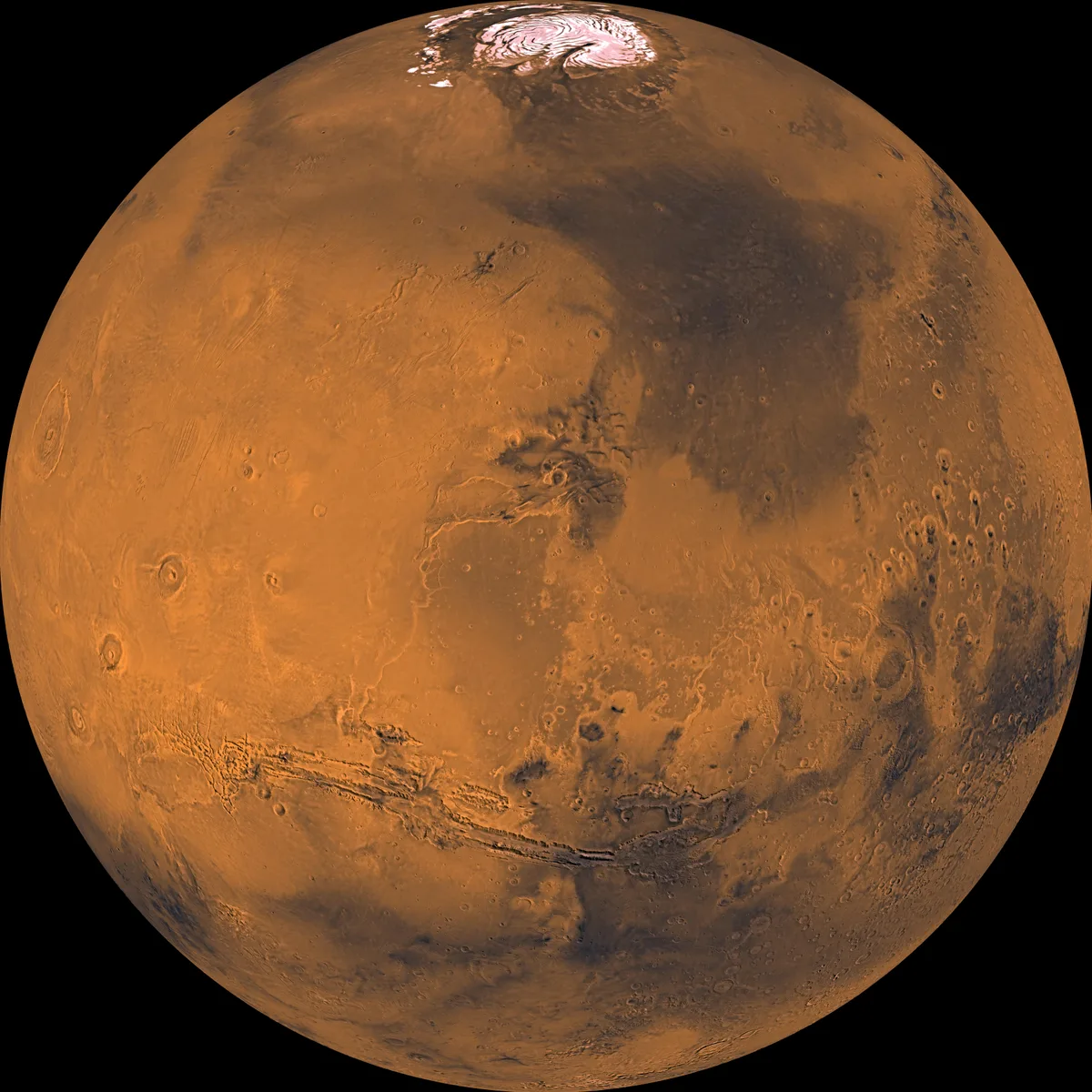
The colour comes from rust. Mars's surface is covered in fine dust rich in iron oxide, the same compound that forms on old iron left in the rain. The wind spreads this dust across the planet and lifts it into the sky. That is why the Martian sky looks butterscotch by day.
Strangely, Martian sunsets are blue. The fine dust scatters blue light forward, so it gathers around the setting Sun.
A World of Extremes
Mars holds some of the most dramatic landscapes in the Solar System.
- Olympus Mons is the largest volcano known in any planet's solar system. It stands about 22 km high, almost three times the height of Everest, and its base is about the size of Poland. It grew so large because Mars has no moving tectonic plates, so lava kept piling up over the same hot spot for millions of years.
- Valles Marineris is a canyon system about 4,000 km long and up to 7 km deep. On Earth it would stretch from New York to Los Angeles. The Grand Canyon would fit inside one of its side branches.
- Hellas Planitia is a giant impact basin about 2,300 km wide and more than 7 km deep. At its floor, the air pressure is high enough that liquid water could briefly survive.
- The polar ice caps are made of water ice topped with a seasonal layer of frozen carbon dioxide. They grow in winter and shrink in summer.
Where Did the Water Go?
Billions of years ago Mars was a very different place. Orbiters and rovers have found dried river valleys, ancient deltas, lake beds and minerals that only form in water. Together they show that early Mars had rivers, lakes and possibly a northern ocean.
So what happened? Mars is small, and its core cooled quickly. When the core cooled, Mars lost its global magnetic field, the shield that protects Earth's air. Without it, the solar wind slowly stripped away much of the Martian atmosphere. As the air thinned, the water either escaped into space or froze underground.
Mars still has a lot of water, just not where we can see it:
- The polar caps hold enough ice to cover the planet in a layer many metres deep if melted.
- Large sheets of buried ice lie just below the surface in the mid-latitudes. These could one day supply future explorers.
- Studies of seismic data from NASA's InSight lander suggest there may be liquid water trapped deep in the crust, many kilometres down.
Weather, Seasons and Dust Storms
Mars is tilted at 25.2°, very close to Earth's 23.4°, so it has seasons too. Each season lasts about twice as long as Earth's, because the Martian year is nearly twice as long.
Its weather is dominated by dust. Local dust storms are common. Every few Martian years, storms join together into a global dust storm that can hide the whole surface for weeks. In 2018 such a storm blocked the sunlight that powered NASA's Opportunity rover and ended its 15-year mission.
Temperatures swing wildly. A summer afternoon at the equator can reach about 20 °C. The same spot can fall below −70 °C that night, and the poles drop to around −125 °C.
Two Tiny Moons
Mars has two small, potato-shaped moons, named after the sons of the Greek god of war:
- Phobos ("fear") is about 22 km across. It orbits so close that it circles Mars three times a day. It is slowly spiralling inward, and in roughly 50 million years it will either crash into Mars or break apart into a ring.
- Deimos ("dread") is only about 12 km across and orbits farther out.
Both may be captured asteroids, or debris from a giant impact on Mars long ago. Future missions aim to find out.
Exploring Mars: A Short History
- 1965: NASA's Mariner 4 makes the first flyby and sends back the first close-up images, showing a cratered world.
- 1971: The Soviet Mars 3 becomes the first craft to land, but it falls silent after about 20 seconds.
- 1976: NASA's Viking 1 and 2 land and search for life. The results are still debated.
- 1997: Sojourner becomes the first rover on another planet.
- 2004: The twin rovers Spirit and Opportunity land and find clear evidence of past water.
- 2012: Curiosity lands in Gale Crater using the daring "sky crane", and it is still driving today.
- 2021: Perseverance lands in Jezero Crater, an ancient lake with a river delta. It begins collecting rock samples for a future return to Earth. Its helicopter, Ingenuity, makes the first powered flight on another planet and goes on to complete 72 flights. The same year, China's Tianwen-1 puts the Zhurong rover on the surface, and the UAE's Hope orbiter begins studying Martian weather.
Mars in 2026: What Is Happening Now
Mars is busier than ever.
- Perseverance and Curiosity are still exploring. Perseverance is climbing beyond the rim of Jezero Crater, studying some of the oldest rocks on the planet.
- A fleet of orbiters from the USA, Europe, India, China and the UAE photograph the surface, monitor the weather and relay rover data back to Earth.
- NASA's twin ESCAPADE spacecraft, launched in late 2025, are heading toward Mars. They will study how the solar wind strips away its atmosphere.
- Sample return missions are being planned by both NASA and China to bring Martian rocks to Earth for the first time, but their exact timing is still uncertain.
Mars and Earth line up for an easy launch window only about every 26 months. The next close approach, called opposition, is in February 2027. That is a great time to see Mars as a bright orange "star" in the night sky.
Could Mars Have Life?
No life has been found on Mars, but the question is far from closed. In 2024, Perseverance found a rock nicknamed "Cheyava Falls" with markings that, on Earth, are often linked to microbes. It is not proof, but it is one of the most intriguing clues yet. It is also exactly why scientists want to bring samples home and study them in Earth's best laboratories.
If life ever existed on Mars, it most likely lived billions of years ago, when the planet was warm and wet. If it survives today, it would probably be microbial and hidden underground, safe from radiation and with access to buried water.
Why Mars Matters
Mars is a time capsule. Its surface has barely changed for billions of years. It holds a record of what happened when a once-wet, Earth-like world lost its air and water. Studying it helps us understand our own planet's past and future.
It is also the most realistic next step for human exploration. It has a day almost as long as ours, water ice to mine, and an atmosphere that can be turned into fuel and oxygen. The first people to walk on Mars may already be alive today.
Further reading on this site: