 XIA LEI
 Clustered orbits
Several of the most distant icy bodies, such as Sedna, have long oval orbits that all point in roughly the same direction. By chance alone, that would be very unlikely.
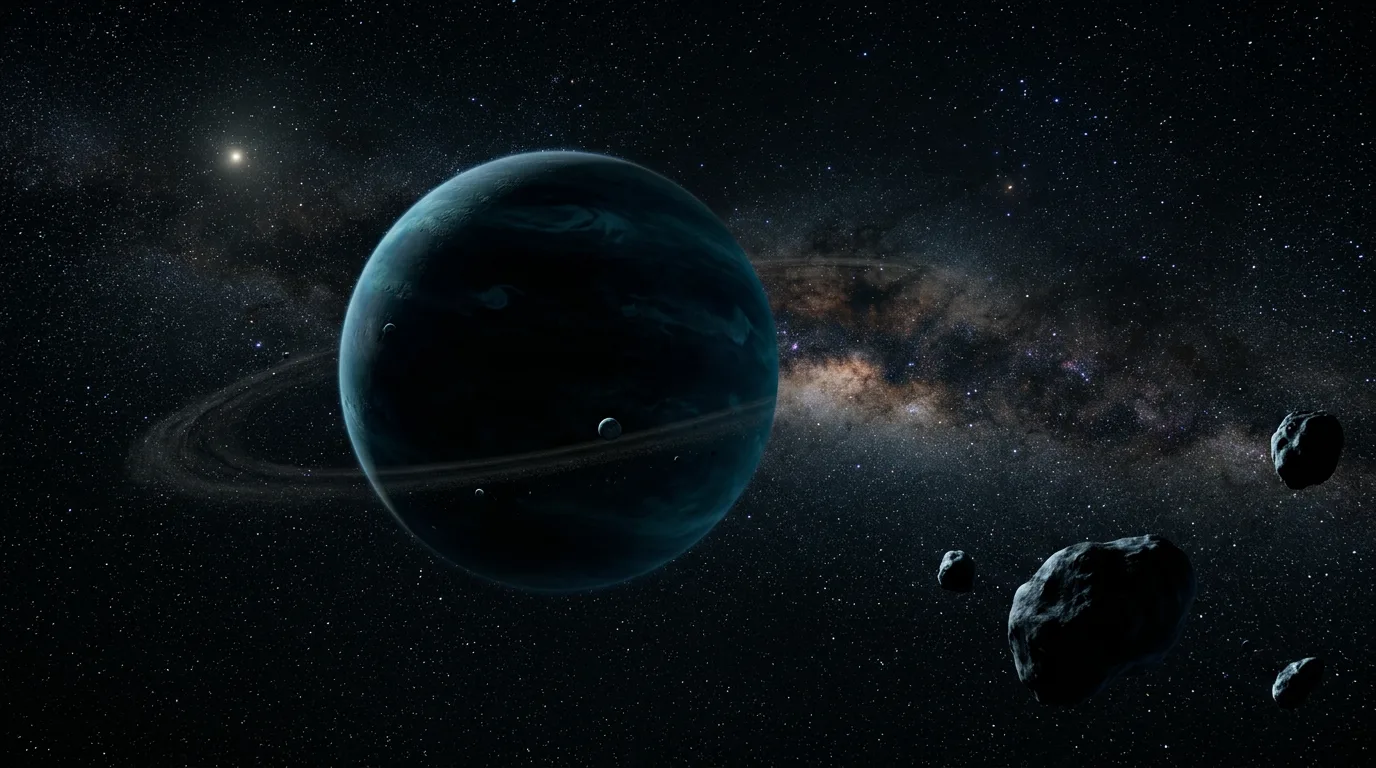
A hidden giant that may circle the Sun far beyond Neptune. No one has seen it yet, so this is how an AI imagines it.
See it on the live map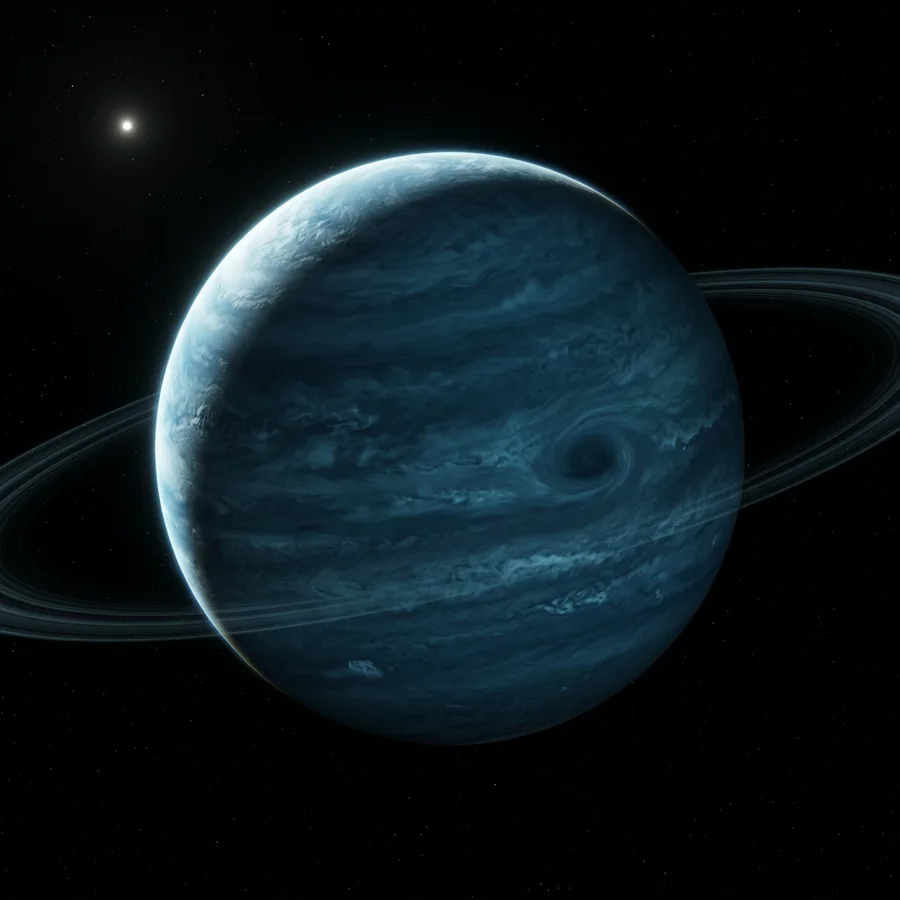
If Planet X is real, it is probably a smaller cousin of Uranus and Neptune: a ball of rock and ice wrapped in a thick hydrogen and helium atmosphere. Traces of methane would absorb red light, giving it a deep blue-teal colour.
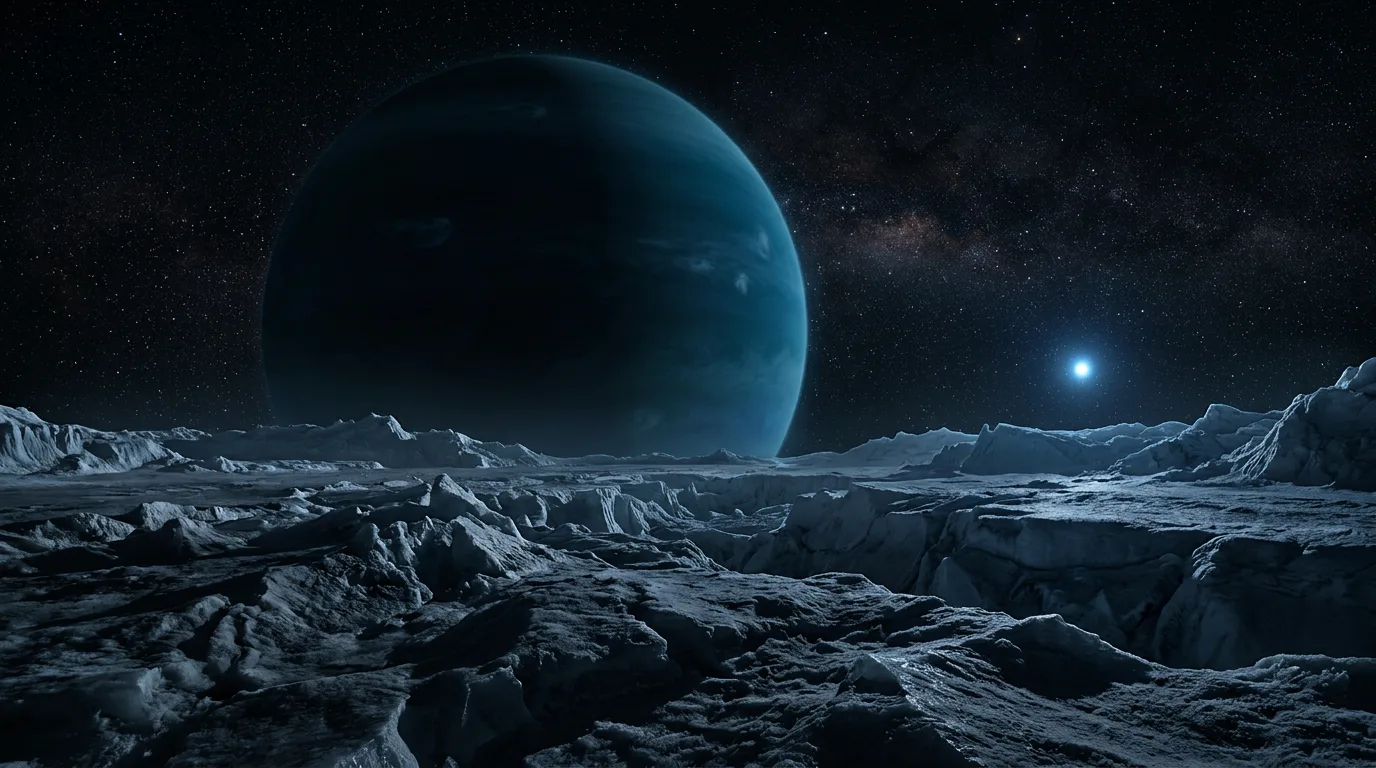
So far from the Sun, daylight there would be dimmer than a full moon on Earth. The Sun would look like little more than an unusually bright star.
These pictures are imagined by AI. They are artistic guesses, not real photos.
In 2016, astronomers Konstantin Batygin and Mike Brown proposed Planet Nine to explain some strange patterns at the edge of the Solar System.
Several of the most distant icy bodies, such as Sedna, have long oval orbits that all point in roughly the same direction. By chance alone, that would be very unlikely.
Some far-off objects travel on orbits tilted steeply, or even backwards, compared to the planets. A massive unseen planet could tug them into those angles over millions of years.
Computer models suggest it spends most of its time near the far end of its orbit, so faint that only the biggest telescopes, such as the Vera C. Rubin Observatory, have a chance of spotting it.
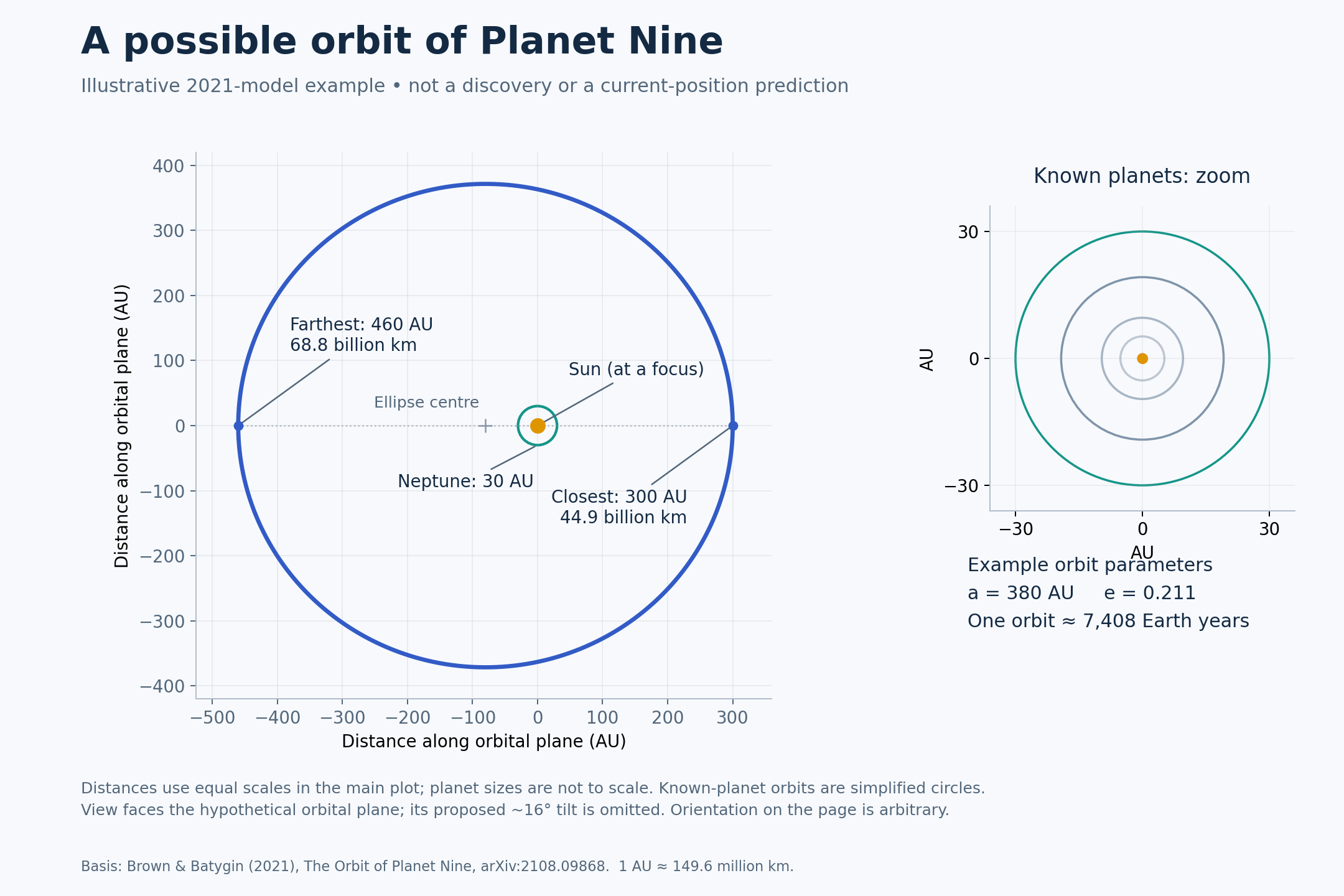
Here is one possible orbit, not a confirmed orbit or the planet’s current location. It uses representative values from Brown and Batygin’s 2021 study. arxiv.org
The blue line is the hypothetical orbit; the small green circle is Neptune’s orbit. The Sun sits off-centre, so the planet’s distance changes even though the ellipse looks almost circular.
For this example, the farthest distance is 460 AU. The “around 500 AU” used on the live map is a rounded model estimate.
They worked backwards from the objects they could observe:
Repeated telescope observations reveal how small icy bodies beyond Neptune move, including their orbital shapes, orientations and tilts.
Computer simulations add a hypothetical planet and calculate how its gravity changes those small bodies’ paths over millions to billions of years. Some simulations reproduce the observed orbital alignment. caltech.edu
Researchers vary the hypothetical planet’s mass, distance, tilt and orbital shape, then compare the resulting patterns with observations.
Objects are easier to discover in some locations than others. The 2021 study included those observational biases and used statistical sampling, called Markov Chain Monte Carlo, to estimate ranges of possible parameters. arxiv.org
The underlying physics is Newton’s gravity:
Here, M and m are the objects’ masses, r is their separation, and G is the gravitational constant. A simulation repeatedly adds the gravitational pulls from the Sun and planets and updates each object’s motion. NASA Science
The drawing uses an orbital half-length, or semimajor axis, of a = 380 AU and a closest distance of q = 300 AU, the study’s reported central estimates. These produce an illustrative ellipse; combining central estimates does not establish a uniquely preferred orbit. arxiv.org
| Quantity | Calculation | Result |
|---|---|---|
| Orbital stretch, e | 1 − q/a = 1 − 300/380 | 0.211 |
| Farthest distance, Q | 2a − q = 760 − 300 | 460 AU |
| Closest distance in kilometres | 300 × 149.6 million | 44.9 billion km |
| Farthest distance in kilometres | 460 × 149.6 million | 68.8 billion km |
Kepler’s third law gives the approximate time for one orbit around the Sun, using AU and Earth years:
That law calculates the period once we assume an orbit; it does not prove a planet exists. NASA Science: Kepler’s Laws
The evidence remains indirect: a model can explain the observed patterns without being the only possible explanation. Finding the planet and tracking its movement would provide much stronger confirmation.
Turn on "Planet Nine" on the live solar system map to see where it might be right now.
Open the live map