 XIA LEI
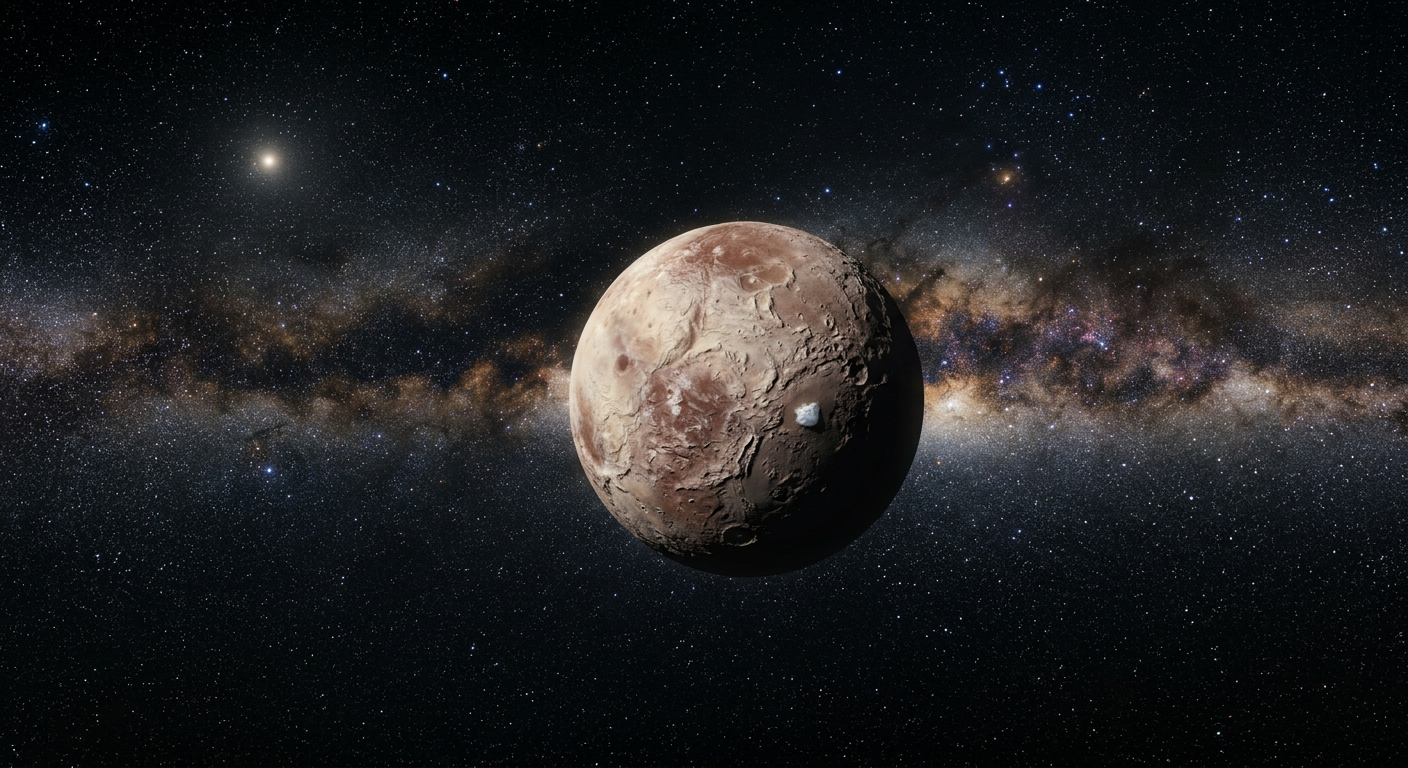
A New World at the Edge of the Solar System
In October 2026, astronomers announced the discovery of 2026 ED138, a large object orbiting the Sun far beyond Neptune. If follow-up observations confirm that it is massive enough to pull itself into a round shape, it could become only the sixth officially recognised dwarf planet, joining Ceres, Pluto, Eris, Haumea and Makemake.
You can see it moving right now on our interactive Solar System map, where it appears among the Kuiper Belt dwarf planets.
How It Was Found
The object was spotted on 13 October 2026 by astronomer Matthew Holman of the Center for Astrophysics | Harvard & Smithsonian. He was running search software he built with colleague Kevin Napier through billions of measurements collected earlier in the year by the NSF–DOE Vera C. Rubin Observatory in Chile.
Rubin carries the largest digital camera ever built and has only just begun its ten-year survey of the southern sky. Finding a world this size so early in the survey is a strong sign of what is still waiting to be discovered.
Once the orbit was known, astronomers searched older images and found the object hiding in data as far back as March 2010 — more than ten years of observations that let its path be calculated with high precision.
Why Nobody Saw It Before
2026 ED138 is surprisingly bright for such a distant object, so why was it missed? The answer is its location in the sky. It sits in front of one of the most crowded star fields of the Milky Way. Against that dense background of stars, a faint, slow-moving dot is very easy to overlook. Rubin's automated pipeline, which compares the same patch of sky night after night, is designed to pick out exactly this kind of moving needle in a stellar haystack.
Key Facts
| Property | Value | |
|---|---|---|
| Average distance from the Sun | 43.1 AU (about 6.4 billion km) | |
| Closest approach (perihelion) | 37.1 AU | |
| Farthest point (aphelion) | 49.1 AU | |
| Current distance | about 46 AU | |
| Orbit shape (eccentricity) | 0.139 | |
| Orbit tilt (inclination) | 24.4° | |
| Time to orbit the Sun | about 283 years | |
| Last closest approach | April 1926 | |
| Next closest approach | around April 2209 | |
| Estimated diameter | 600 to 1,500 km | |
| Brightness in the sky | magnitude ~20 (needs a large telescope) |
1 AU is the distance from Earth to the Sun, about 150 million km.
What Kind of Object Is It?
2026 ED138 belongs to the Kuiper Belt, the icy ring of leftover building blocks beyond Neptune that is also home to Pluto. Its orbit is moderately stretched and tilted by almost 25 degrees, which makes it a "hot" classical Kuiper Belt object. "Hot" does not refer to temperature — the surface is likely around –230 °C — but to its stirred-up orbit. Objects like this are thought to have been pushed outward and tilted long ago, when the giant planets shifted their positions in the young Solar System.
How big is it really?
Astronomers measure how much sunlight it reflects, but not yet how reflective its surface is. A dark surface means a big object; a bright, icy surface means a smaller one. That is why the size estimate spans 600 to 1,500 km. At the upper end it would rival Makemake and Haumea; even at the lower end it is one of the larger bodies found in the outer Solar System in years.
Will It Become an Official Dwarf Planet?
To qualify, an object must orbit the Sun, not be a moon, and be massive enough that its own gravity has made it round. The next steps are:
- Thermal measurements with telescopes such as JWST or ALMA to pin down its size and reflectivity
- Light-curve studies to see how its brightness changes as it spins — a clue to its shape
- A search for moons — if it has one, astronomers can weigh it precisely from the moon's orbit
If those results show it is big and round, the International Astronomical Union could recognise it as a dwarf planet and it would receive a permanent name.
Many More May Be Waiting
The discovery team estimates that several more objects of this size may still be hiding in the outer Solar System, especially in crowded parts of the sky that older surveys struggled with. As Rubin continues its survey, the list of known dwarf planets — and our map — may grow quickly.
Explore It Yourself
Open our Solar System map, find 2026 ED138 among the Kuiper Belt objects, and select it to see where it is today. Compare its orbit with Pluto, Eris and Makemake, and watch how slowly it moves — one lap takes almost three centuries.